
Security lessons from our southern neighbour
At the time I am writing this article, I’ve just finished attending the 42nd Annual Security Seminar and Expo, put on by Jewelers’ Security Alliance (JSA). They are the Jewellers Vigilance Canada (JVC) equivalent in the United States, but on a much larger scale. While this seminar is geared towards the U.S. market, the security and crime issues faced by the U.S. jewellery industry are very similar to the issues in Canada. I’m going to highlight some of my takeaways and some lessons learned as they relate to the Canadian jewellery industry.
Smash-and-grab robberies
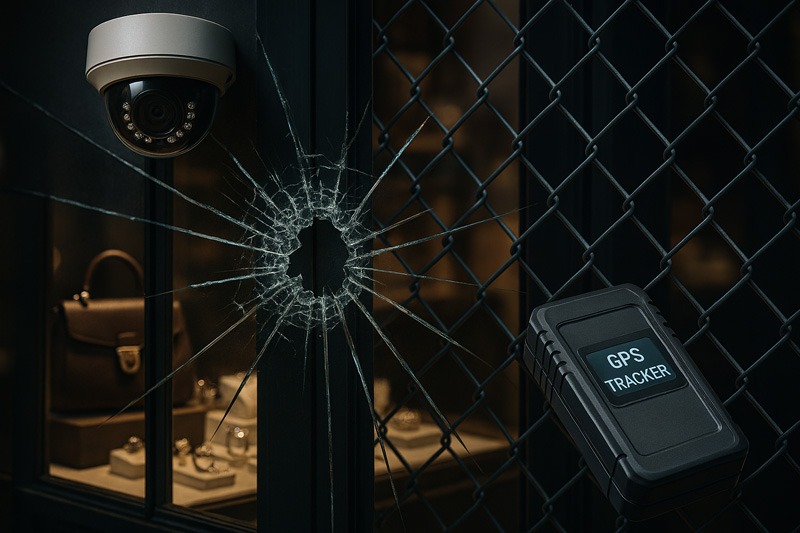
Four or five years ago, these were practically unheard of, but they have become an all-too-common risk for jewellery retailers. In my talks, presentations, and webinars, I have been advocating to jewellers that being able to control your store entrances is critical to prevention, and this point was echoed by JSA’s Scott Guginsky. I watched surveillance video of an event, and similar to Canada, the thieves gathered in stolen vehicles before entering the store and then smashed through cases and stole large amounts of jewellery. The elderly store owner suffered a stroke and a heart attack when the thieves pushed him to the ground. The store had a controlled-access door lock, and while staff saw them coming, a staff member accidentally pressed the door lock entry button in a panic. This reinforces two points: 1) Control your entry (if you can), 2) Train your staff.
Vehicles being used to ram through storefronts is just as big a problem in the U.S., and few options can stop a 4,000-lb vehicle. Traffic bollards are the best, and possibly the only, defence against this kind of threat. If you’re exploring options, there are many models available that can match the style of the area. You’re not limited to yellow cemented pillars.
Perimeter protection
Every jeweller has some form of alarm system to be alerted of a potential crime; however, you have to wait until a sensor is triggered, which means an attempted entry has already occurred. Staying aware of activities outside your store can be an important step in preventing crime. Mat Smitheman from Interface demonstrated an exterior unit that only needs power to operate. This device is mounted outside the store and works with AI-equipped cameras to monitor your exterior. It can identify when people are doing more than just walking by and deliver pre-recorded messages to deter would-be thieves. If individuals continue to loiter, the AI detects this and routes the video to a live human at a monitoring centre, who can communicate with them via a two-way device built into the unit.
GPS tracking of high-value items
Dan Kopchick from Ensurity gave a presentation on GPS devices that can be embedded in jewellery pillows and show boxes, providing nearly live information (approximately every 20 seconds) on the device’s location once it detects movement. The battery in these devices can be charged wirelessly and can last six months or more before needing to be recharged. When actively transmitting, the device’s battery can last up to three weeks. This is more than enough time to get an accurate location. I won’t get into all the details in this article, but several methods and strategies are involved in deploying a GPS program. On this note, I want to touch on the use of Apple AirTags. While there have been some success stories with them, they are not designed to give real-time location data, and they are easily discoverable when deployed due to Apple’s concerns about anti-stalking with their use.
Alarm systems, jamming, and safe attacks
On the more advanced end, organized crime groups have become highly skilled in their break-in tactics. Some are gaining entry through the roof, conducting construction work beforehand, and waiting for the store to be closed on a Sunday or long weekend. They then use jamming devices to overwhelm the wireless signals of your security system. DGA Security offers a device called Jam Guard, which can be installed with any security system; it detects jamming devices and alerts the alarm centre. These sophisticated criminals wait to see the response, and if no one shows up to check the whole perimeter, they enter and proceed to target your safe.
As I mentioned in a previous article, it’s important to remember that you should have your alarm system inspected once a year, test it quarterly, and make sure your call list is updated with people who will answer the phone. A common issue in the U.S., as we have here in Canada, is that keyholders don’t answer the phone, or the alarm company is calling people who are no longer employed. Remember to get all the numbers of your alarm centre so you can program them to override any “do not disturb” blocks on your phone.
Safe attacks are less common in Canada, but this tactic can be easily communicated to those here in the North. If you don’t have a seismic or vibration sensor installed on your safe, you should consider installing one and also think about a device like Jam Guard that will notify you if your system might be down due to jamming.
Jewellers Vigilance Canada (JVC) is a non-profit subsidiary of the Canadian Jewellers Association with a mandate “to advance loss prevention within the jewellery industry.” JVC also works closely with law enforcement agencies in Canada through their Crime Prevention Program. For more information, visit www.jewellerycrimecanada.ca.
Scott Hayes is a security advisor and independent security consultant with Jewellers Vigilance Canada (JVC). He retired with over 28 years of experience in law enforcement, having spent the last 15 years investigating organized crime on a national and international level. He is a Certified Protection Professional (CPP) with ASIS Int’l and an Associate Business Continuity Professional (ABCP) with DRI Int’l. relations firm Luxury Brand Group.
Sign up for our newsletter
Get all the latest news and features from Jewellery Business. Submit your email below to get our twice-monthly newsletter.
Products






Read the Latest Issue
