
August, written in stone
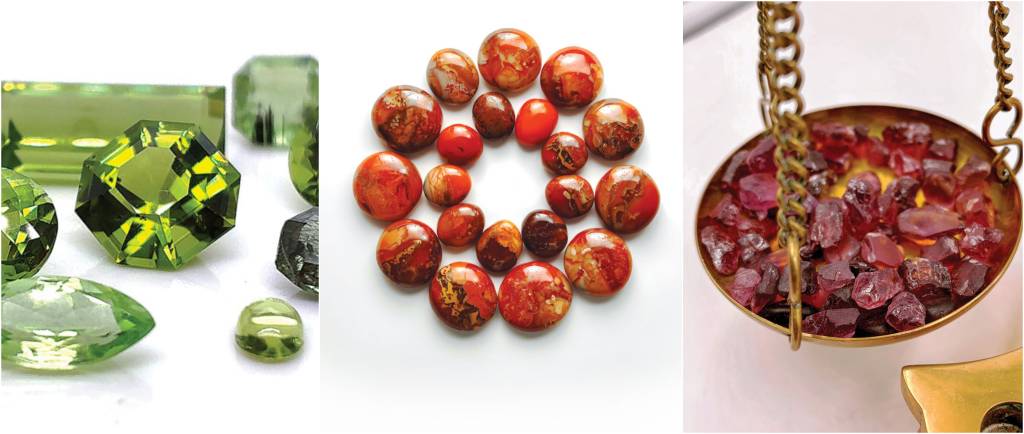
The tradition of birthstones is a long one. It dates back thousands of years, and it is deeply rooted in religion, culture, and astrological beliefs. Even today, people underestimate the impact birthstones can have on us. Each month of the year gets, in general, two or three gemstones assigned to it. The origin of those assignments is rooted in religious belief, symbolism, and later, in more modern times, the jewellery industry standardization.
Birthstone jewellery is a great market for jewellers, and a classic to get for presents and events alike.
The month of August is a very special month, because unlike many other months that have different birthstones in American and European traditions, August was historically associated with just one primary gemstone in each tradition. But from 2016, the month of August got a new gemstone assigned to it, totalling three gemstones we’ll see today.
Peridot
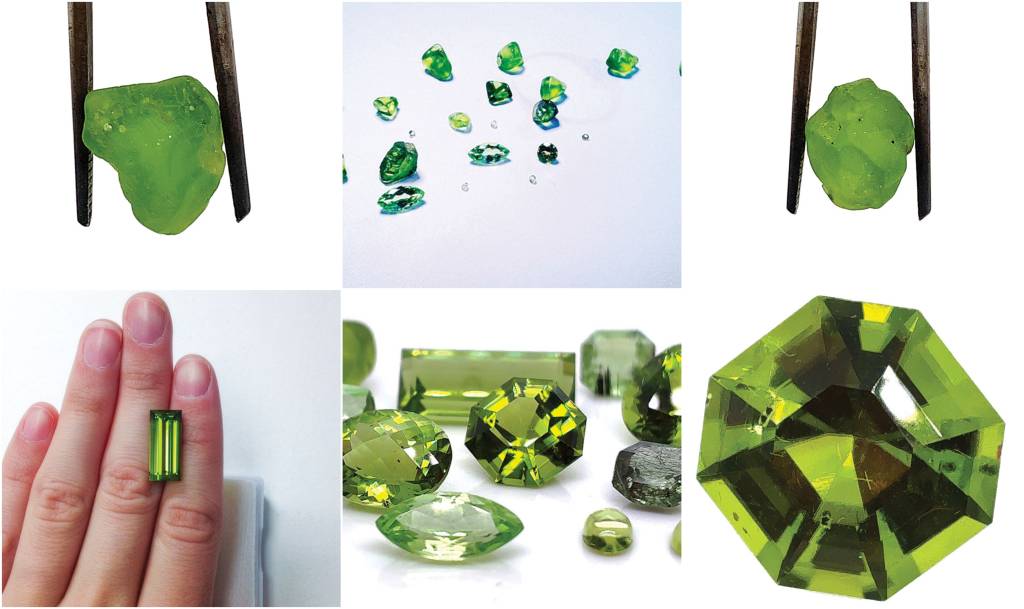
The one we all know is peridot, this semi-precious variety of olivine, also called forsterite. Known for its vibrant olive green to yellowish colour, it is well-known and loved. The ancient Egyptians referred to it as the “gemstone of the sun.” They believed it offered them protection and brought them good fortune.
With a hardness of 6.5 to 7 on the Mohs scale, this gem is hard enough for jewellery, but generally fragile to chemicals and heat. So, one must be cautious when handling it. It is easily recognizable under the loupe or microscope for its strong double refraction, meaning you see the facet edges and inclusions in double!
The green colour is associated with summer and abundance. Although the exact reason is unclear, the National Association of Jewelers (now Jewelers of America) in the United States has recognized peridot as August’s birthstone. Peridot is not a stone that is generally treated. It doesn’t take the heat well, and while some rough peridot will have oil on it to make it look better, what you see on the market is often without treatment.
Peridot is an inexpensive gemstone until it hits three carats or more in size. When it gets big and clear of inclusions, the prices often double or even triple, because bigger and cleaner peridots are very hard to find today.
Fun fact: Peridot is one of the rare gemstones that can be found in Pallasite meteorites—meaning some peridot have celestial origins!
Some important sources for peridot (historically and presently) include China, the United States, Myanmar, Egypt, and Pakistan.
Sardonyx
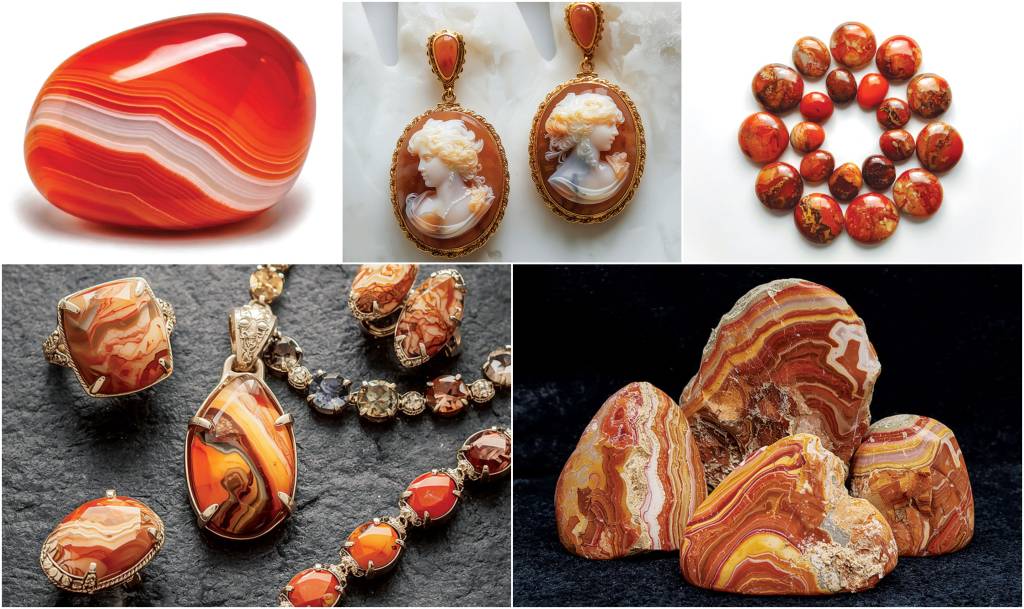
Sardonyx is the original and first August birthstone and is more popular in Europe than in America. It’s a variety of chalcedony that comes from the Quartz family (the same big family that has citrine, amethyst, onyx, jasper, smoky quartz, and so on).
Sardonyx is typically a layered semi-precious gemstone, with sard (the reddish-brown colour) and white chalcedony. This gives it a banded pattern from deep red to orange, to red and white, or orange and white.
Often used to make cameos, this material has a hardness of 7 on the Mohs scale. The bands, if there are any, are usually parallel to each other, creating a unique look to the gemstone.
As unassuming as it looks, it’s one of the most important gemstones of the ancient world. When you come across some antique rings that have cameos on them, and the cameos themselves are white, with a red or orange background, those are generally natural sardonyx.
It was used extensively by the ancient Greeks and Romans for seals and rings with portraits (signet rings), and it was loved by artisans around the world for its potential as a carving material.
It is believed to be one of the original gemstones associated with the breastplate of Aaron, which is believed to be the first artifact used to depict the birthstones.
This gemstone is highly resistant to daily wear, making it ideal for all types of jewellery.
Sardonyx treatments typically involve dyeing to enhance colour contrast and heating to darken certain bands. Otherwise, the stone remains untreated.
Sardonyx today is not an expensive gemstone, but I would be careful of collector’s stones like handmade and antique cameos, or items with historical value. That’s where the treasures are with sardonyx!
Some important sources for sardonyx (historically and presently) include India, Brazil, Uruguay, Germany, and Madagascar.
Spinel
Spinel is the newest and latest addition to the birthstone family.
The Jewelers of America added it as the August birthstone in 2016—only 10 years ago!
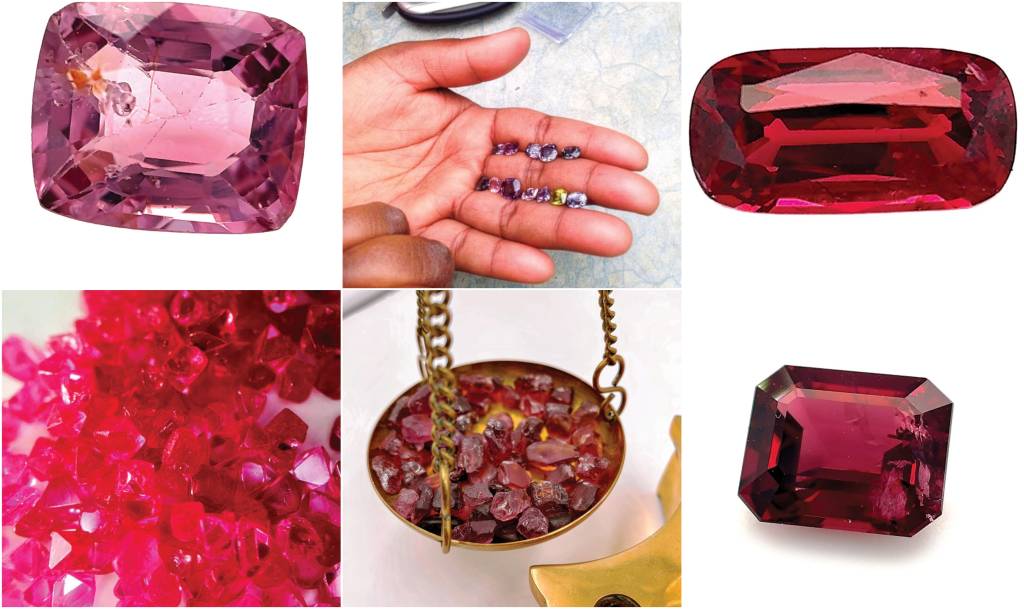
Spinel is arguably one of the most underrated but fascinating gemstones there is. The name comes from Latin “spina,” meaning arrow, because of the arrow-like shape of the rough (double pyramids or octahedra).
Spinel has a Mohs hardness of 8, indicating it is a highly durable gemstone that withstands heat well and remains chemically stable overall.
The colours range from a pale reddish orange to a deep red to a beautiful cobalt blue, easily competing with the ruby and the sapphire beauty. Bright pink, grey, and even black are colours found in spinel. Like garnet and tourmaline, spinel has a large arsenal of colours available to us.
Fun fact: Before modern science was invented, no one could tell the difference between a spinel (MgAl2O3) and a ruby (Al2O3); the colours can be extremely similar, as is the chemical composition. It wasn’t until the late 18th century that we developed the technology necessary to distinguish spinel as a separate mineral from ruby. However, gem traders in Myanmar were the first to recognize spinel as being distinctly different from ruby in the late 1500s. This all led to some spinels being mistaken for rubies in the past. Amongst them is the famous Black Prince’s ruby in the British crown jewels (still called a ruby in the museum description of the royal crown today). Balas ruby and spinel-ruby are some of the old names we used before people simply decided to call it spinel. Some important sources for spinel (historically and presently) include Sri-Lanka, Afghanistan, Myanmar, Tanzania, Madagascar, Vietnam, and a few other countries lucky enough to have them in the soil.
Some important sources for spinel (historically and presently) include Sri-Lanka, Afghanistan, Myanmar, Tanzania, Madagascar, Vietnam, and a few other countries lucky enough to have them in the soil.
Lucky August babies
In the end, August is one of the most fascinating months when it comes to birthstones. From the bright green glow of peridot to the historical importance of sardonyx, and finally the colourful and newest addition of spinel, each gemstone tells a different story shaped by history, culture, and astrology. Together, these three gems represent thousands of years of human fascination with beauty, symbolism, and rarity. Whether chosen for their meaning, their durability, or simply their appearance, August birthstones continue to hold a special place in both the gemstone world and in jewellery traditions around the globe. I’ll add that August has a special place in my heart because it’s also my birth month.
Lauriane Lognay is a fellow of the Gemmological Association of Great Britain (FGA) and has won several awards. She is a gemstone dealer who works with jewellers to help them decide on the best stones for their designs. Lognay owns Rippana, Inc., a Montréal-based company that offers coloured gemstone, lapidary, and jewellery services. She can be reached at rippanainfo@gmail.com.
Sign up for our newsletter
Get all the latest news and features from Jewellery Business. Submit your email below to get our twice-monthly newsletter.
Products



Read the Latest Issue
