
Production workflows: From AI hype to practical impact
Artificial Intelligence (AI) dominates retail conversations, yet much of the discussion remains disconnected from the daily realities of jewellery businesses. Retailers hear plenty about consumer-facing tools such as image generators or chatbots, but far less about how technology can meaningfully relieve long-standing operational bottlenecks in content production, customization, and visual consistency.
A quieter shift is already underway. Instead of attempting to replace craftsmanship or creative judgment, jewellery retailers are applying automation and AI to the most repetitive, structured parts of their workflows: preparing visual assets, adapting designs, managing variations, and standardizing output. The value of these systems lies not in novelty, but in reliability. They help teams work faster, maintain consistency, and scale operations without compromising quality.
This shift is less about adopting AI for its own sake and more about rethinking workflows that were never designed for today’s volume of digital content or the growing demand for customizable jewellery.
Where traditional jewellery workflows break down
Modern jewellery retail demands an enormous volume of visual content. High-quality still images, spinners, videos, and lifestyle visuals are required across websites, marketplaces, and social platforms. At the same time, customers increasingly expect to explore different gemstone options, metal variations, and configurations before committing to a purchase.
In luxury and jewellery e-commerce, this challenge is compounded by relatively low baseline conversion rates. Industry benchmarks suggest that conversion rates for jewellery and accessories often sit below 1.5 per cent, making every source of friction more consequential. According to data published by OpenSend,1 converting browsers into buyers in this category is inherently difficult, increasing the importance of clarity, trust, and presentation.
Behind the scenes, many of the workflows supporting this content remain fragmented and labour-intensive. Much of the work is repetitive: selecting frames, removing backgrounds, correcting orientation, maintaining consistent scale, and preparing assets for publishing. Even when creativity is not the limiting factor, the sheer volume of technical effort creates bottlenecks that slow launches and constrain how many variations can realistically be shown.
Legacy content introduces another layer of complexity. Large image libraries built over many years often no longer meet current presentation standards. Gemstones may appear too small in frame, the resolution may be insufficient, and the source footage may no longer be available. Re-shooting entire inventories is rarely practical.
What AI looks like in real operations
Three case studies
The AI systems gaining traction in jewellery retail today are largely invisible to shoppers. They operate behind the scenes, automating tasks that are rule-based, repeatable, and time-consuming, while leaving perceptual and creative decisions to humans.
Automating gemstone content production from turntable videos
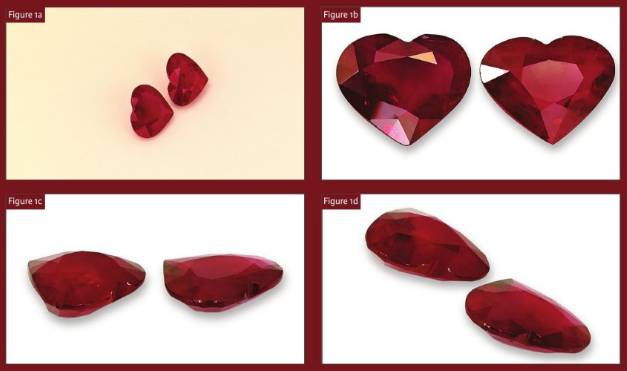
One example is gemstone content production. In one large-scale operation, each gemstone turntable video editing process previously required manual cine-loop selection, keyframe extraction, orientation correction, background removal, shadow creation, and compositing. These steps followed consistent rules, yet demanded significant hands-on effort from skilled staff.
Automation restructured this workflow. Cine-loops and keyframes were selected automatically, frontal views were oriented consistently, gemstones were accurately segmented, backgrounds removed, and realistic shadows generated. Advances in AI-based segmentation have made gemstone isolation in controlled product imagery reliable enough for production use, eliminating the need for manual masking.
Scale normalization ensured that selected keyframes maintained consistent stone size across images, preventing visual “jumping” between views. What remained deliberately human-controlled was colour correction. Accurate gemstone colour cannot be determined algorithmically alone; trained operators compare on-screen results with the physical stone under specific illumination conditions. Rather than attempting to automate this judgment, the system generated intelligently varied galleries of colour-corrected options, allowing humans to quickly and consistently select the closest perceptual match.
Taken together, these changes reduced processing time per gemstone from roughly 30 to 40 minutes to about two minutes, without compromising quality and while improving consistency across outputs. Exemplary results are available in Figure 1.
Upgrading legacy imagery without re-shooting inventory
Automation also addresses a less visible but widespread problem: legacy gemstone imagery that no longer meets modern e-commerce standards.
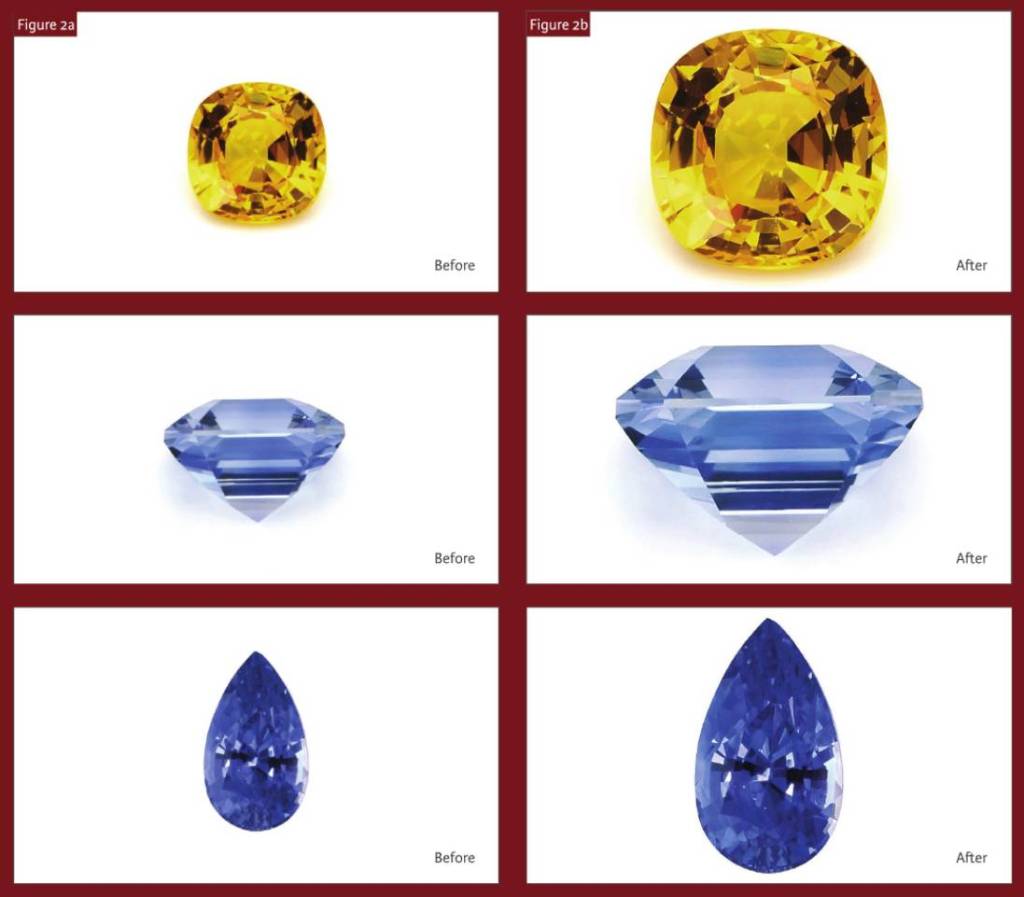
Many legacy images require significant enlargement to meet current layout and resolution requirements. Traditional upscaling methods often introduce blur and loss of detail. In this context, AI-based super-resolution can be applied conservatively to increase resolution while preserving edge detail, rather than inventing or stylizing content.
Accurate AI-based gemstone segmentation enables automated reframing, allowing stones to occupy a defined portion of the image and producing consistent composition across different SKUs. Once configured, the process runs in batch mode and requires no significant manual labour beyond output verification.
The practical outcome is straightforward but impactful: hundreds of gemstones can be upgraded to current presentation standards without re-shooting inventory, bringing older assets in line with newer content and restoring visual consistency across the catalogue. Examples of legacy imagery versus AI-enabled reframed results are available in Figure 2.
Making customization operationally viable
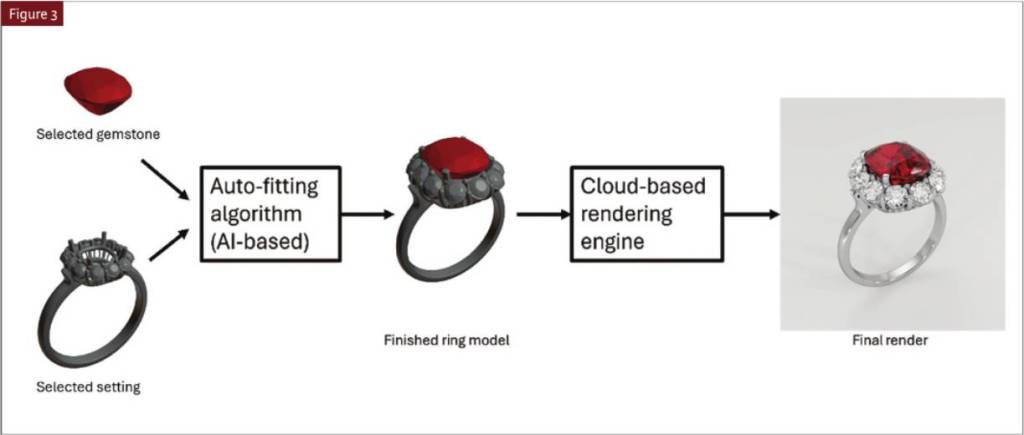
Customization presents a different challenge. For made-to-order jewellery, each product configuration represents a unique combination of setting and gemstone. Visual content for these configurations has long been produced using a 3D-first workflow: modelling the item and rendering images or spinners. Visual quality was not the issue; the lack of scalability was.
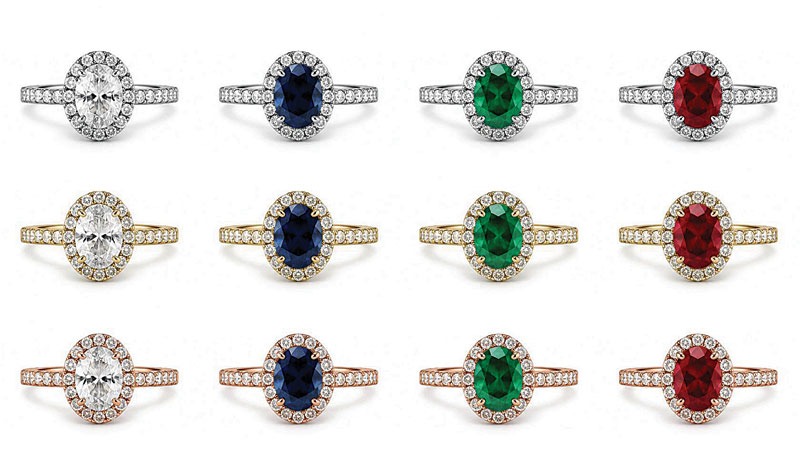
By automating gemstone fitting into settings and standardizing and deploying the rendering pipeline to cost-effective cloud resources, the same 3D workflow could be executed repeatedly and reliably across many configurations, without manual intervention for each variation. This made it feasible to visualize a broader range of configurations consistently, supporting customization as a scalable offering rather than a labour-intensive exception, and reducing the required manual work from 45 to 90 minutes per item (complexity-dependent) to mere minutes spent on quality assurance. See Figure 3 for details.
How roles are changing for skilled staff
Automation often raises concerns about the impact on designers, technical artists, and production teams. In practice, the changes observed in jewellery workflows are more nuanced.
Automation targets repetitive, procedural tasks: selecting frames, applying consistent transformations, cleaning backgrounds, or preparing assets. When these steps are handled automatically, the benefit is not only an increase in scale, but skilled staff move from manual execution to supervision, validation, and creative decision-making. Their expertise remains essential, particularly where perceptual judgment is required, such as gemstone colour accuracy.
Industry surveys reinforce the scale of this challenge. Research published by PhotoRoom2 indicates that nearly half of jewellery brands refresh product imagery at least quarterly, with many editing hundreds of images per month, often with limited dedicated resources.
Customer-facing benefits retailers actually feel
Although these systems operate behind the scenes, their effects are visible to customers. Faster content production shortens the time between product availability and launch. Consistent visuals strengthen brand credibility and reduce friction in the buying process.
Jewellery-specific e-commerce experts consistently emphasize the role of rich, detailed visuals in bridging the sensory gap of online shopping. According to industry commentary published by Bright River,3 multiple views, close-ups, and high-quality presentations help build confidence and engagement in jewellery e-commerce.
Academic research further supports this view. Studies examining online retail behaviour4 have shown that lighting, background, and photographic presentation influence perceived attractiveness and purchase decisions.
Understanding the limits
Automation is not a silver bullet. Systems must be integrated thoughtfully, and quality control remains essential. Some steps, particularly those involving perception and esthetics, still require human oversight. Successful projects begin with a clear understanding of existing workflows and focus on removing friction rather than layering technology on top.
The most effective solutions mirror how teams already work, replacing only the steps that benefit from consistency and scale.
Why this matters for Canadian jewellery retailers
Canadian jewellery retailers face the same pressures shaping global markets, often with leaner teams and tighter margins. Competing with larger e-commerce players, managing rising costs, and meeting expectations for speed and customization are ongoing challenges.
Automation offers a way to increase operational capacity without proportionally increasing headcount. By streamlining production workflows, retailers can respond more quickly to demand, expand assortments, and maintain consistent presentation across digital channels.
Moving beyond the hype
As AI becomes less novel and more operational, the question for jewellery retailers is no longer whether these tools belong in production workflows, but how deliberately they are adopted. The most successful implementations are rarely the most ambitious, but the most pragmatic: those that remove friction, respect human expertise, and scale what already works. For retailers navigating rising expectations and increasing complexity, the challenge is not keeping up with technology, but deciding which parts of their workflows are finally ready to let go of manual constraints.
Notes
1 Read OpenSend’s “7 Case Studies of Successful Jewelry & Accessories Online eCommerce Stores” here: https://www.opensend.com/post/successful-jewelry-accessories-online-ecommerce-stores
2 See PhotoRoom’s “Jewelry Photography Insights From 1,000+ E-commerce Sellers” here: https://www.photoroom.com/blog/jewelry-photography-ecommerce
3 See Bright River’s “Are Your Product Images Secretly Sabotaging Your Online Jewelry Sales?” here: https://bright-river.com/boost-jewelry-sales-with-quality-visuals/
4 Read ResearchGate’s “Product Photography in Product Attractiveness Perception and E-commerce Customer Purchase Decisions” here: https://www.researchgate.net/publication/368904227_Product_photography_in_product_attractiveness_perception_and_e-commerce_customer_purchase_decisions
Eliran Dahan is an entrepreneur and technology executive with more than 20 years of experience developing large-scale software and imaging systems used by tens of millions of users worldwide. He has led technology companies from early concept through venture funding and global deployment. Dahan is a co-inventor on four US patents and holds a B.Sc. in electrical engineering from the Technion—Israel Institute of Technology. He is the CEO and co-founder of 3D Foundry Labs, a company that builds custom AI and 3D solutions for the jewellery industry.
Tal Kenig is a technology leader with more than 20 years of experience in computer vision, machine learning, and imaging systems, both as an engineer and as a CTO. He has led the development of advanced vision and imaging platforms for multinational companies, including GE Healthcare and Samsung Electronics, as well as for technology startups. Tal serves as a scientific reviewer for multiple IEEE publications, is a co-inventor on nine US patents, and holds a B.Sc. in Biomedical Engineering and an M.Sc. in Electrical Engineering (Summa Cum Laude) from the Technion – Israel Institute of Technology. He is the CTO and co-founder of 3D Foundry Labs, a company that builds custom AI and 3D solutions for the jewellery industry.
Sign up for our newsletter
Get all the latest news and features from Jewellery Business. Submit your email below to get our twice-monthly newsletter.
Products



Read the Latest Issue
