
A sparkling retrospective: 20 years of Jewellery Business
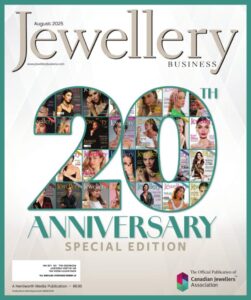
Call it writers’ bias (or even a cliché), but I believe the most precious gems are often found between the lines.
In the debut issue of Jewellery Business, and several that followed, the magazine featured a column called Readers’ Forum, described by its first editor, Carol Besler, as “representing an opinion, beef, business tip or analysis from anyone in the industry.” In that August 2005 issue, two pieces dove into an emerging trend—and is now ubiquitous: internet retail. Both were compelling, but what stood out to me was the conversation about competing with—or simply understanding—the internet. A timely discussion back then, it signaled a new era, much like the launch of the magazine itself.
The Forum offered sharp takes on everything from jewellery taxation to the role of the Canadian Jewellers Association.
As Jewellery Business celebrates its 20th anniversary, I took a walk through the archives—unearthing stories that still shimmer with insight, charm, and relevance. Choosing just a few favourites was nearly impossible—each issue sparkled in its own way. But these features caught my eye for how they reflect the shifting heart of the jewellery world, through evolving tastes, technologies, and traditions. Here are a few of those highlights.
Wild women: June 2006
“The wonders of high watchmaking” by Carol Besler includes a striking subsection titled “Cartier’s tribute to wild women.” Naturally, I had to know what counted as a “wild woman” in 2006. The answer? Delightfully unexpected. The reference is to María Félix, a 1940s Mexican film star known for her femme fatale roles. She once commissioned a necklace in the shape of her beloved pet… a baby crocodile. Years after her death at age 88, Cartier honoured her legacy by launching the La Doña watch collection in Geneva at the Salon International de la Haute Horlogerie in her name. While the other timepieces in the collection are also stunning, this one stands out—not just for its design, but for its backstory.
Going green, early: December 2008
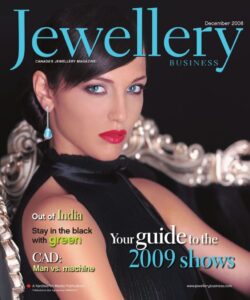 In her publisher’s note, “The new green: Maybe Kermit was wrong” (huge props for that headline), Ellen Kral tackled a topic that proves sustainability has always been in style. “Perhaps the biggest question of all is: what does it mean to be green?” she wrote. “I have seen many jewellers tout their products using terms such as ‘fair trade jewellery,’ or ‘eco jewellery.’ Do they mean anything? Not really, given there are no real standards governing the use of such terminology. The question as to whether this is right or wrong is best saved for another time.” In other words, just because it’s stamped “eco” doesn’t mean it’s guilt-free.
Greenwashing wasn’t born yesterday, and in jewellery, the sparkle can sometimes outshine the substance. Turns out, as much as I may like that headline, Kermit perhaps was onto something: it’s not easy being green.
Nature-inspired jewels: June 2009
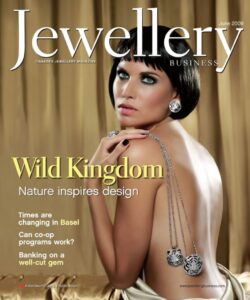 She returned to the theme in June 2009, referencing Earth Day and quoting consumer trend firm “Trendwatching.com: The future has never looked greener… mainly because creating a more sustainable economy is not an option, but a necessity.” Kral saw this as an opportunity for the jewellery industry to claim a stake in the eco-conscious marketplace. She asked the same question many still do: Is this trend here to stay?
At the time, sustainability was more than a buzzword. Perhaps, even a challenge knocking at the industry’s door. Have things changed since then? And if so, how much? The industry is different today—but it’s always worth reflecting on how we got here, who pushed for standards, and where we go next.
That same issue also included “Wild things: Jewellery takes its lead from Mother Nature,” a beautiful feature by Deborah Yonick about reconnecting with nature. “Our desire to return to natural elements is encouraged by our fast-paced, techno-savvy lifestyles that have us more connected to digital devices than the people and environments around us,” she wrote. A prescient point—consider how much more digital we’ve become since. The jewellery showcased—bug rings, butterfly brooches, turtle pendants—was both whimsical and grounding. “I love the juxtaposition of gems and insects. You just don’t think of them together,” said London designer Stephen Webster.
The charm of choice: 2012
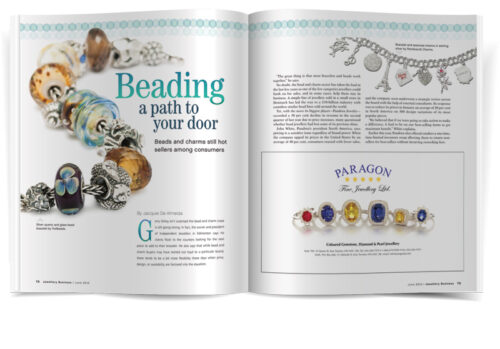
Jacquie De Almeida captured the height of the bead-and-charm craze in “Beading a path to your door.” Whether collected for beauty or gifted for symbolism, charms were versatile and personal. This piece was an early nod to the emotional storytelling consumers would increasingly crave—jewellery not just worn but lived with.
Title: Beading a path to your door: Beads and charms
still hot sellers among consumers
Gemstone crushes: 2013
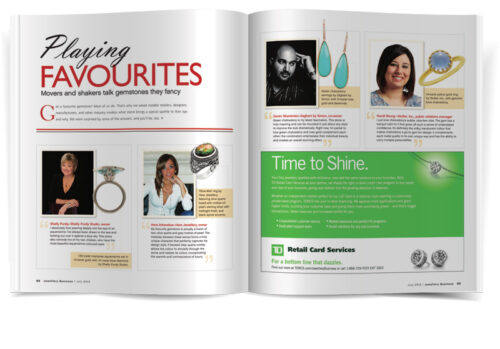
In “Playing favourites,” the magazine asked jewellers to name their favourite gemstones—and the answers were telling. Spinel, pearls, and everything in between reflected not just esthetic preferences but emotional connections. “Asking a jeweller to pick a favourite gemstone is like asking a parent to choose a favourite child… Impossible!” said one. A male jeweller added: “Although I love working with all gemstones, pearls have to top my list. They offer variety, complexity, and a mystery I find completely compelling. Given the proliferation of pearl farming around the world in recent years, we are no longer limited to the little white Akoya strand worn by Sweet 16s in sweater sets. Today, there is a pearl to suit every woman and even a few fashion-conscious men.”
This piece shines in its intimacy, capturing how personal and poetic gemstone selection can be in an industry often focused on price tags and clarity grades.
Title: Playing favourites: Movers and shakers talk
gemstones they fancy
Rings from the stars: 2014
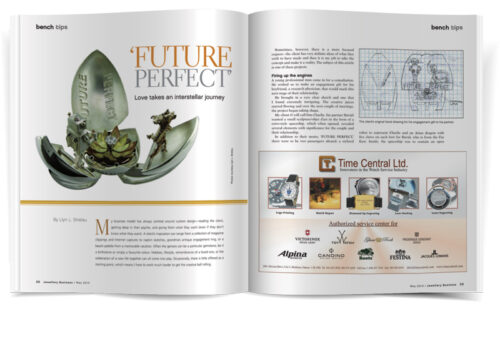
Llyn L. Strelau wrote “Future perfect,” which follows how a Canadian designer brought a client’s fantastical sketch to life as an interstellar-inspired engagement ring. Think dragons, robots, and retro-futurism—all rolled into a deeply personal sculpture. A brilliant reminder of what jewellery can become when imagination leads—a love story, a personal mythology.
Title: ‘Future perfect’: Love takes an interstellar journey
The science of sparkle: 2015
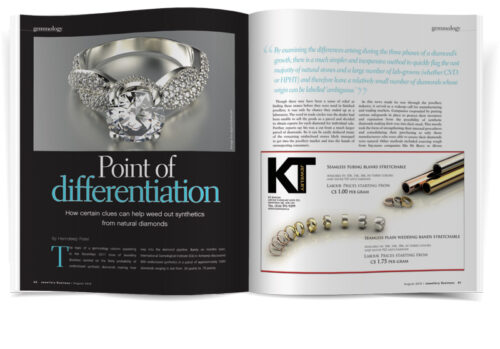
In “Point of differentiation,” Hemdeep Patel sounded the alarm on synthetic diamonds. Citing a 2011 Jewellery Business article about a discovery by IGI Antwerp of 600 fakes in a parcel of 1,000 stones, the article explained how to identify lab-grown stones—and why it matters. Years before synthetics became a mainstream concern, Jewellery Business was already on the case.
This is an example of trade journalism doing what it does best: informing, alerting, and staying one step ahead.
Title: Point of differentiation: How certain clues
can help weed out synthetics from natural diamonds
Design meets discipline: 2016
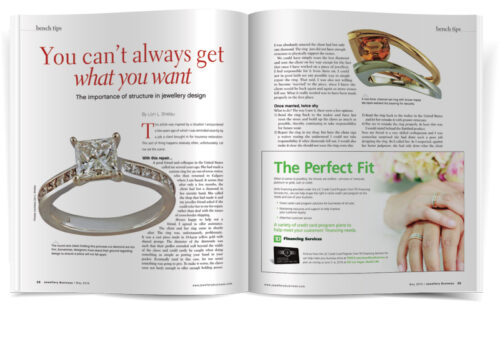
Strelau returned with “You can’t always get what you want,” a case study and a cautionary tale in design failure and ethical responsibility. A poorly built eternity band led to a lost stone, a strained client relationship, and a broader conversation about the importance of craftsmanship and communication. Jewellery is emotional—but its integrity must be structural.
Title: You can’t always get what you want:
The importance of structure in jewellery design
Gold and glamour in Vicenza: 2018
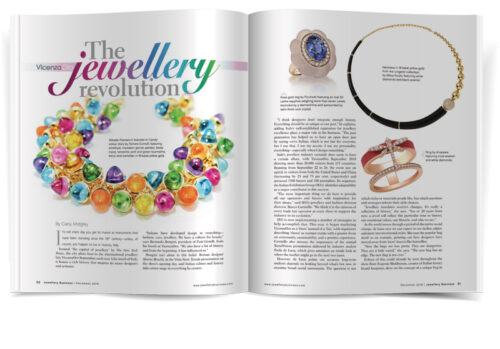
VicenzaOro 2018 wasn’t just a trade show—it was a window into the evolving identity of global jewellery. Captured and curated by Carly Midgley, the event featured more than 20,000 visitors from 117 countries, mixing tradition with bold design experimentation. The message at the trade show was clear: jewellery was becoming more conceptual, expressive, and cross-cultural.
This dispatch stood out for placing design trends within a broader social context, tracing how societal shifts shape the jewellery we wear.
VicenzaOro: The jewellery revolution
Ethics and exclusion: 2020
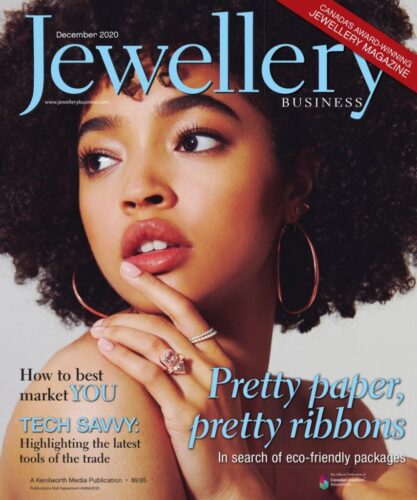
The journey of jewellery, like all fashion, is often cyclical. And so we circle back to the December 2020 issue, where group publisher Erik Tolles reflected on how the online world was reshaping the industry—particularly the synchronization of digital and physical experiences. And yes, both he and the issue discussed sustainability and sustainable packaging. So here we are, years later, still asking many of the same questions.
I’ll leave it to the experts to assess how far we’ve come. I can’t claim to know. But I do believe this: the conversation matters. And Jewellery Business has helped keep that conversation alive.
One of my favourite articles from that same issue dives into the ethics of sourcing. Written by Marc Choyt and Kyle Abram Bi, it examines the systemic racism and structural barriers that Black, Indigenous, and People of Colour (BIPOC) face in the jewellery industry. “I didn’t even know Black people could design jewellery,” one award-winning designer was told—an experience that reveals just how deep these issues run.
While the ethical jewellery movement—sparked in part by the 2006 film Blood Diamond—has led to significant progress in responsible sourcing, the authors argue that BIPOC communities, who supply much of the industry’s raw materials, remain underrepresented. Their critical question: after all this time and effort, what has been the impact on the ground?
Title: “Where Black lives don’t matter to jewellers”
By Marc Choyt and Kyle Abram Bi
The illusion of responsibility: August 2022
In “Sourcing ‘responsible’ diamonds: Where morality meets storytelling,” Choyt and Bi return to the subject—this time peeling back the layers of “responsible sourcing” to show how the label often shields corporate interests. They highlight the controversial role of Alrosa, expose loopholes in industry standards, and call out oversight failures by bodies like the Responsible Jewellery Council.
A pearl’s new purpose: 2024
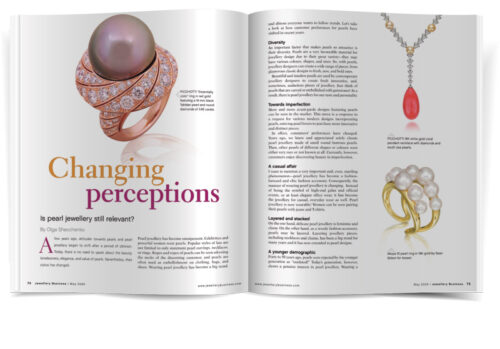
Once typecast as matronly, pearls have re-entered the style conversation with flair. Gemmologist Olga Shevchenko traced their evolution from prim to punk—baroque, colourful, and often gender-fluid. Worn with denim or layered with chains, pearls today challenge conventions while staying rooted
in elegance.
This story captures a cultural turning point, paving the way for the pearl to become a canvas for individuality in an age yearning for authenticity.
Title: Changing perceptions: Is pearl jewellery still relevant?
Too much of a good thing?: 2025
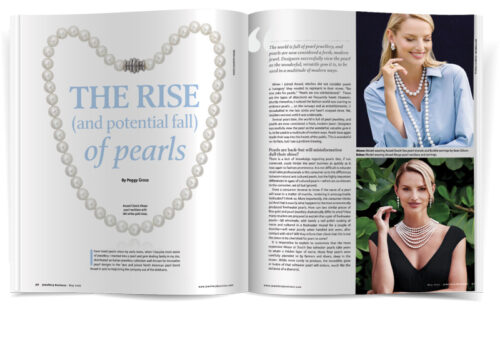
Jewellery veteran Peggy Grosz warns that the pearl’s rapid resurgence risks backfiring without proper consumer education. Misunderstandings around freshwater versus saltwater pearls, grading standards, and origin stories can undermine trust at the sales counter. Her plea: better transparency from suppliers and retailers alike.
This is the counterpoint to trend stories—reminding us that style without substance risks spoiling the magic we’re celebrating.
Title: The rise (and potential fall) of pearls
A quiet favourite from two decades of covers
As a former competitive swimmer, the July 2018 cover with Michael Phelps struck a deeper chord—less about glamour, more about grit. Fast forward to July 2024, and Allyson Felix brought that same athletic grace and personal strength to the frame—visually powerful, emotionally grounded. And then there was Aishwarya Rai in June 2010. Seeing an Indian icon front and centre—not exoticized, not explained, just there—wasn’t just exciting. It was overdue. Representation, after all, isn’t a favour. Representation is a responsibility. What Jewellery Business has consistently done well is frame its covers not as standalone fashion portraits, but as dialogues between subject and adornment. The celebrity ambassadors aren’t simply modelling—they’re in conversation with the jewellery they wear. It’s a reminder that jewellery, at its best, reflects belonging. But the one that’s stayed with me most is May 2018. It was a bridal issue. Elegant, minimal, and deeply intentional. If you’ve read this far, you’ve probably figured it out—I’m a pearl girl through and through. So when that issue gave us a simple dress, a single strand, and soft black-and-white photography, I was sold. The jewellery didn’t scream for attention. It whispered meaning. Of course, the bridal issue is always a standout—for any jewellery magazine and the industry. It speaks to a significant market and some of life’s most meaningful moments. That quiet feeling when jewellery doesn’t demand attention but instead frames a moment. Could that be because I spent all of last year planning my own wedding? I don’t know. Maybe. But this cover stayed with me. Here’s to the next 20 years. |
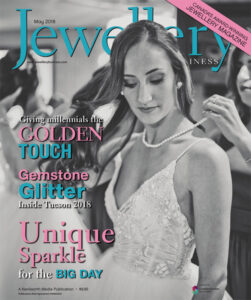 Choosing a single standout from Jewellery Business’s 20-year run isn’t easy—especially when many covers have made lasting impressions. As a lifelong film enthusiast, I’ve always appreciated when Jewellery Business brings cinematic icons into the fold. Seeing Kate Winslet on the
 Marika Gabriel is an editor and communications professional whose career spans two continents. She is the editor of Sign Media Canada, a sister publication at Kenilworth Media Inc.
Sign up for our newsletter
Get all the latest news and features from Jewellery Business. Submit your email below to get our twice-monthly newsletter.
Products


Read the Latest Issue
