
Synthetic gems in antique and vintage jewellery
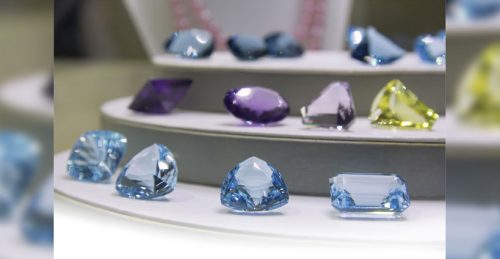
In 1782, Antoine Lavoisier became the first person to fuse ruby and to crystallize it from powdered aluminum oxide (Al2O3), its chemical component. However, it wasn’t until 1873 that French chemist Auguste Verneuil was able to invent a commercially viable process for making synthetic corundum, a.k.a. ruby and sapphire, which is a crystallized form of aluminum oxide. Afterwards, Verneuil synthetic ruby and sapphire began to appear in antique jewellery.
Synthetic emerald
In 1848, J. J. Ebelman was probably the first person to obtain synthetic emerald crystals. However, according to the winter 2015 issue of Gems & Gemology, it wasn’t until the mid-1920s that Prof. Richard Nacken of Frankfurt grew the first gem-quality synthetic emeralds that were large enough to be faceted.
Carroll Chatham (1914-1983) began marketing flux-grown emeralds in the 1930s. He got his start with experiments in his family’s garage. One day, his father accidentally turned off the power supply to his project, and that act caused emerald crystals to grow inside the crucible. The Chatham website says it took him three years to understand why the emeralds formed. When he did, he founded the company that bears his name.
Antique and vintage period jewellery
Antique jewellery is any jewellery that is 100 or more years old, as defined by the Canada Borders Service Agency and the United States Customs Bureau. The World Jewellery Confederation (CIBJO) defines vintage jewellery as pieces created between 30 and 100 years ago. Antique and vintage jewellery is often classified by the time period in which it was made, as follows:
Georgian 1714–1837 (reigns of King George I to King George IV)
Victorian 1837–1901 (reign of Queen Victoria)
Edwardian 1901–1915 (reign of King Edward VII between 1901–1910)
Art Deco 1915–1940
Retro 1939–1950
Victorian jewellery (1837-1901)
Intricate designs, nature motifs, enamelling, cameos, lavalieres, yellow gold, and silver over gold were common during the Victorian period. Diamonds usually ranged from rose cuts to old mine cuts and old European cuts. Pearls were natural and often seed-sized. Typical coloured gem materials included turquoise, garnet, amethyst, agate, jet, ruby, sapphire, coral, and. black onyx.
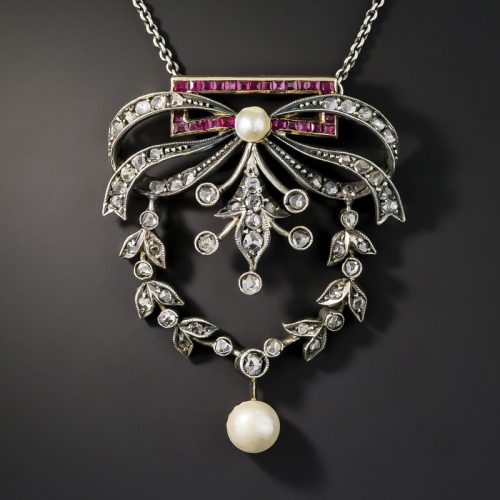
Synthetic ruby did not appear in Victorian jewellery until the late Victorian period. The lavaliere in Figure 1 from Lang Antiques is an example. It is set with rose-cut diamonds, blister pearls, and synthetic rubies in silver over gold.
Edwardian jewellery (1901-1915)
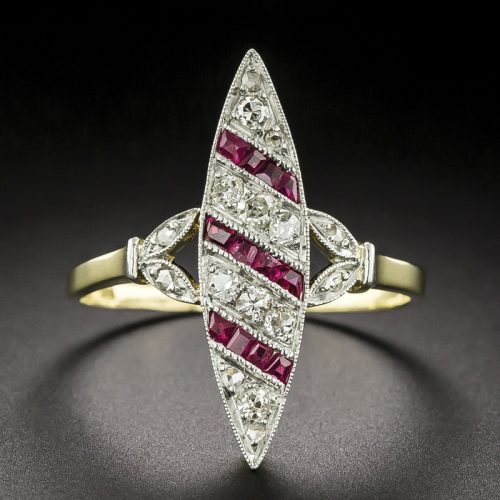
The Edwardian era is known for its delicate lace-like mountings and its heavy use of diamonds, pearls, and platinum. New gem cuts such as the emerald cut and baguette emerged during this period, thanks to improvements in diamond-cutting technology. Calibrated stones of standardized sizes and shapes became available for use in mass-produced jewellery. Milgrain borders like those on the ring in Figure 2 were another characteristic of Edwardian jewellery. It is set with calibrated emerald-cut synthetic rubies and single and rose-cut diamonds. During this period, synthetic rubies and sapphires were considered an improvement over their natural counterparts because of the uniformity of their colour and flawless clarity.
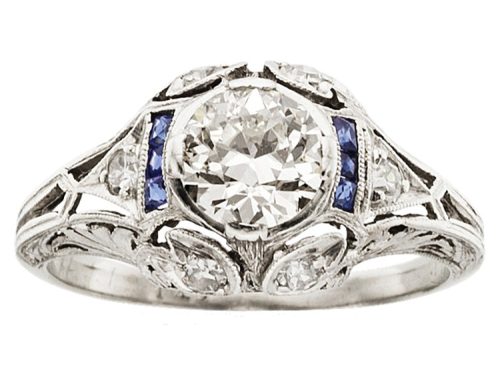
Figure 3 shows an example of emerald-cut synthetic sapphires in a platinum ring set with a one-carat European cut accented with single-cut diamonds.
Art Deco jewellery (1915-1940)
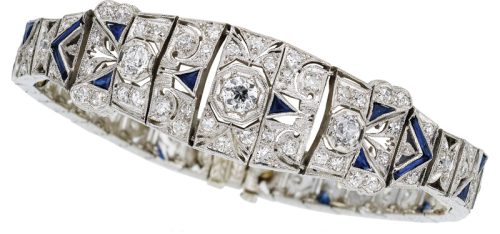
The Cubism art movement inspired geometric patterns and straight lines in Art Deco jewellery. Platinum, milgrain borders, and diamonds continued to be used extensively, but white gold became more popular, and there was a greater use of coloured gemstones such as sapphire, emerald, lapis lazuli, coral, and black onyx. New shapes for side stones emerged in the form of triangles, bullets, half-moons, and shields. The platinum bracelet from Heritage Auctions in Figure 4 is a good example of an Art Deco piece. It is set with baguette and triangle-shaped synthetic sapphires and European and single-cut diamonds. One of the most popular types of jewellery was the diamond straight-line bracelet, which was revived during the 1980s and called the tennis bracelet.
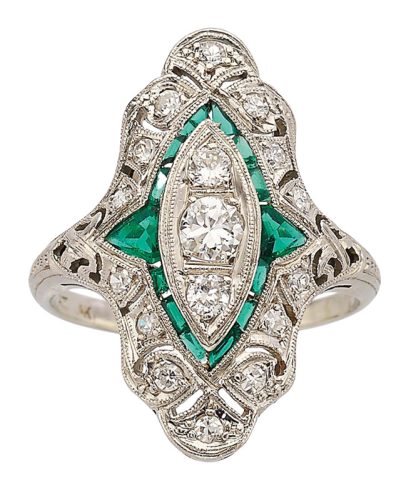
Another Art Deco example is the platinum ring in Figure 5, which has milgrain borders and synthetic emeralds in rectangular and triangular shapes. Carved jade was also a popular green gemstone during the Art Deco period.
Louis Cartier is the most famous Art Deco designer. The works of Van Cleef & Arpels also had a strong influence on the period. Other leading designers and houses were Mauboussin, Jean Fouquet, Boucheron, Chaumet, and the American firms of Tiffany & Co., Black, Starr & Frost, J.E. Caldwell & Co., Harry Winston, and Shreve, Crump & Low.
Retro jewellery (1939-1950)
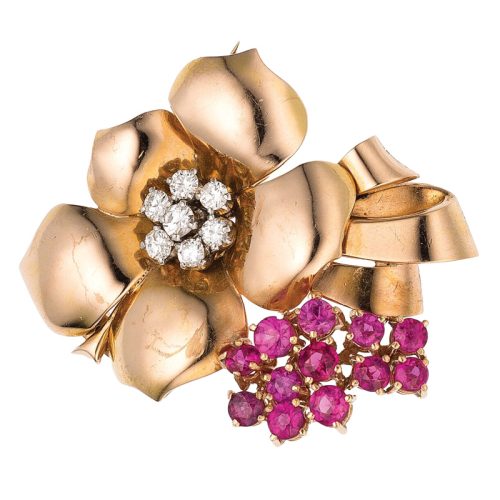
Most Retro jewellery was made with yellow and rose gold because the U.S. government declared platinum a strategic metal during World War II, although some was made with white gold or palladium. Coloured gems such as citrine, aquamarine, topaz, and tourmaline were often used in addition to sapphires, emeralds, and especially natural and synthetic rubies. Common motifs were flowers, scrolls, bows, and belt buckles. Retro designs were bold and three-dimensional, often with domed shapes like the brooch from Heritage Auctions in Figure 6. It is set with synthetic rubies and modern round brilliant-cut diamonds.
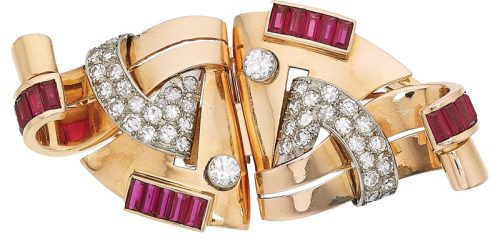
Convertible pieces, which were popular during the Art Deco era, continued to be made during the Retro period, but they usually had gold mountings and designs with more flowing lines. The synthetic ruby and diamond double-clip brooch in Figure 7 is an example. The clips can be worn separately or together as a larger brooch.
Post-World War II jewellery and synthetic gems
After the war, platinum returned in jewellery and pieces emphasizing diamonds became more widespread. Synthetic gems gradually became more available from a wider variety of sources. In 1947, the Linde division of Union Carbide began producing and selling star rubies. Several years later, Linde introduced synthetic blue star sapphires.
In 1959, Carroll Chatham started marketing synthetic rubies by the flux technique in addition to his synthetic emeralds. Since then, many firms have used this method to synthesize corundum.
In the early 1960s, Pierre Gilson, a French ceramic tile producer, succeeded in growing flux synthetic emerald. According to a report in a winter 2018 Gems & Gemology article, Gilson commanded 95 per cent of the world market by the mid-1970s. Since the 1980s, hydrothermal emeralds from Australia, Russia, and Thailand have been available and used in jewellery.
Gem synthesis has not been limited to ruby, sapphire, and emerald. Other synthesized gem materials include spinel, opal, quartz, diamond, alexandrite, lapis lazuli, and turquoise. The motivation for creating synthetic gems goes beyond jewellery use. Diamond, spinel, and quartz were initially synthesized for their potential industrial applications in machinery and as cutting instruments, optical components and semiconductors. Their uniform, attractive appearance, availability, and affordability are added benefits. It is no wonder that they are more widely used in modern jewellery today than in vintage and antique jewellery.
Renée Newman, GG, is a gemmologist and the author of the 3rd edition of the Gemstone Buying Guide: How to evaluate, identify, select & care for colored gems and 14 other books on jewellery and gems. She became interested in gems while conducting tours to Asia, South America, and the South Pacific in the early 1980s. To answer her passengers’ questions about the gems there, Newman enrolled in the Gemological Institute of America (GIA) gemmology program. After graduating, she was hired as a gemmologist at a diamond and gemstone wholesale firm in Los Angeles, and now devotes most of her time to speaking and writing about gems and jewellery. For more information about Newman and her books, visit www.ReneeNewman.com.
Sign up for our newsletter
Get all the latest news and features from Jewellery Business. Submit your email below to get our twice-monthly newsletter.
Products

Read the Latest Issue
