
The timeless allure of turquoise explained
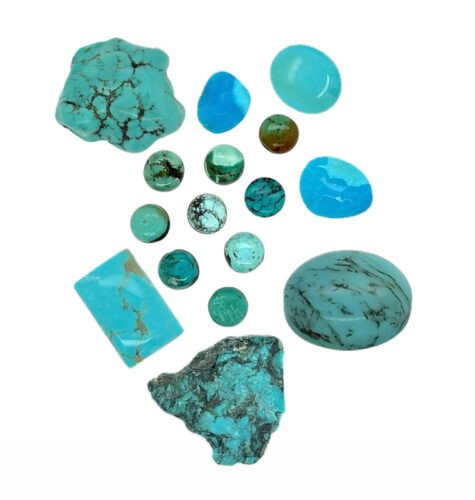
What is a turquoise? It’s not only a colour, or the December birthstone, but an important gem in the jewellery business that has been around for millions of years! Amongst the oldest gemstones ever used by humans, with over 3,000 years of history, turquoise is unlike any other gem on the market. Often thought of as just a low-quality tumbled stone by many, it has, multiple times in history, been used by royalty and the biggest jewellery houses in the world. Its unique appearance makes it easy to make bespoke pieces that last. It’s also why it’s a gemstone that is often imitated and treated.
Structure
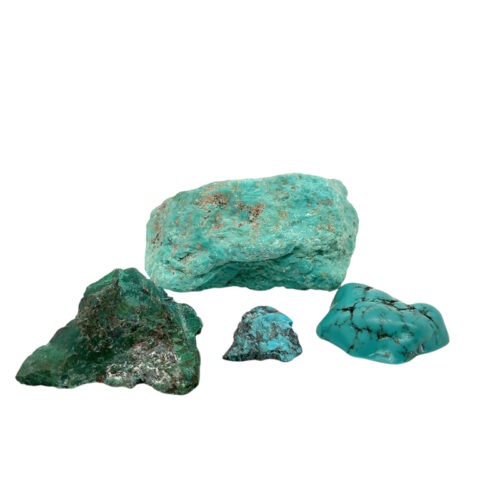
It’s a gemstone that doesn’t really show crystalline structure, even though it has one. The appearance is most of the time reminiscent of bubble gum. The crystalline system is triclinic, but most of the time the rough shape is amorphous or botryoidal in nature. The crystals are so small, they appear as cryptocrystalline masses instead of big single crystals like quartz and beryls.
In simpler terms, you cannot see the structure with the naked eye or even with a standard microscope, but it exists and is not amorphous, unlike opal, for example. Turquoise has a hardness of 5 to 6 on the Mohs scale, making it a rather fragile gemstone. It has a waxy lustre, often appearing matte or shiny like a candy.
Purity in colour
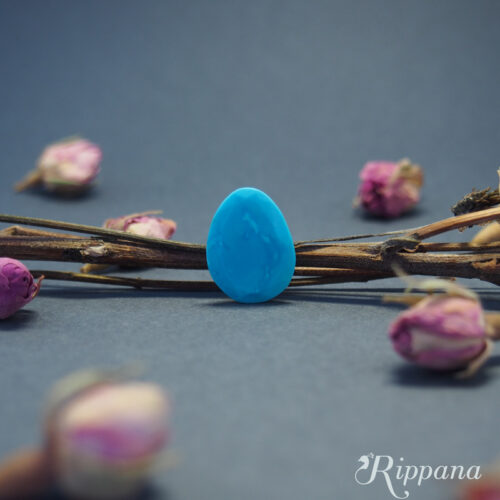
The main colour is, well, turquoise. Going from baby blue, to pale blue, to green, to yellowish green and a mix of all of those. The colour normally depends on the quantity of copper (for the blue) and iron (for the green) in its content.
The iron content is also why some turquoise over the years might oxidize and turn from blue to more greenish on the surface. Most of the time, a simple polish can bring back its original colour hiding underneath.
The most rare and coveted colour is called “sleeping beauty,” also called “robin’s egg blue” or “Persian blue,” depending on where it came from. No blemishes, no dead spots, no cracks or fissures filled with “sand.’’ Pure homochromatic blue is the one you want.
However, depending on your clients’ tastes, some prefer their turquoise with imperfections, as proof of it being natural. Matrix patterns, as we call it, can be different colours, like gold, brown, or black. Some collectors put value on the intricate patterns more than the perfect appearance of the gemstone itself.
Origins
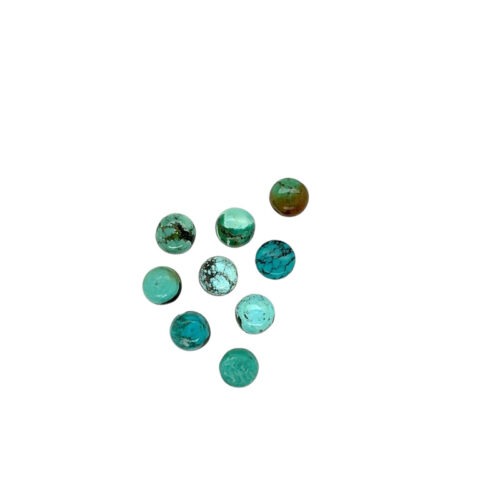
Iran (Persia) is historically famous for having the best and oldest found turquoises in the world, but you can also find incomparable beauties in the United States (Arizona, Nevada, New Mexico), Egypt, China, Mexico, Chile, Afghanistan, Tibet, and more.
Each origin with their own unique features and colours.
Rulers of ancient Egypt used to adorn themselves in turquoise jewellery, Aztecs used them for ceremonies, and it was sacred, and carvings of Chinese origins found dated back to more than three thousand years. Turquoise is also the official gemstone of Tibet.
Today, the turquoise gemstone represents not only a part of history, but it is also named the main December gemstone.
What’s in a name?
The origin of the name comes from what the French called “pierre Turque,” meaning Turkish gemstone in English. Over the years, the name became turquoise, also symbolizing the origin of the turquoise gemstone introduction to Europe in the Middle Ages. Today, the name not only symbolizes the gemstone, it has also created its own named colour recognized worldwide.
Treatments
Stabilization
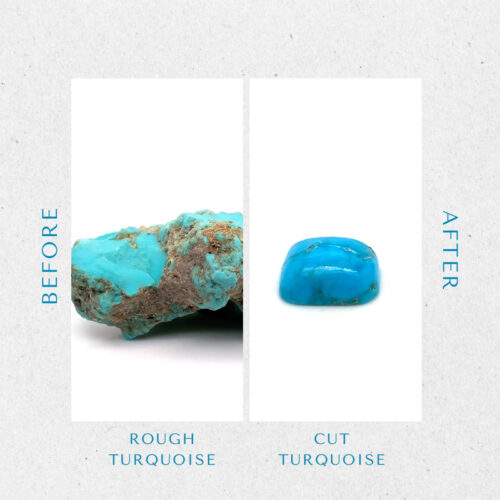
Since turquoise is known to be a porous gemstone, it is common for it to be stabilized in order to cut it and use it in jewellery.
If not, it would be too soft to cut and brittle to use. Stabilization implicates a certain mix of resin and or plastic introduced into the stone, making it more durable for everyday wear and easier to polish when cutting it. This treatment is considered normal on the market and even wanted, for it makes working with turquoise infinitely easier.
Dye
Turquoise is often dyed to make its appearance more pleasing.
The colour could be too pale, or too green, or not evenly distributed.
The dye is often a surface treatment, meaning it is unstable and could be gone after a little dip in the acetone of a simple re-polish by a lapidary.
Jewellers have to be careful when handling client gemstones or buying them. Checking under the microscope for concentrated coloured areas or slightly scratching the surface can help determine if it’s the real colour or not. Otherwise, you might get a surprise!
Not to be confused with turquoise that was oxidized and turned more green with time.
You will see a difference after polishing, but it’s not skin-deep dye, it’s the natural colour of the turquoise. This dyeing must be disclosed when bought, as it’s generally not an accepted treatment.
Imitations
Reconstitution or composite turquoise
Because the original gemstone doesn’t exist anymore, this is not considered a treatment, but an imitation. It’s powdered turquoise that is bonded with resin to create a new “naturally looking” turquoise. It must be disclosed, as it is not considered a real turquoise or accepted in the market. They will often have black and brown cracks, all over, difficult for the everyday person to distinguish from real, because of their “natural-looking inclusions.” Make sure your sources are sure.
Howlite and magnetite
You have a lot of dyed howlite and magnetite on the market to imitate turquoise. Those can be distinguished by gemmologists and tested. Technics for testing include hardness, density, colour, re-polishing, and surface appearance.
Also, ceramics, plastic, and companies like Gilson, are making the closest that we have to synthetics, but are still considered imitations.
“Modernize the old, but remember the gold”
A little saying I like to write once in a while. In this case, we have to remember that turquoise is a part of our history, a part of the jewellery industry, and not just vintage pieces that you see occasionally. Renowned jewellery houses modernized it in contemporary and modern pieces, cementing its place in high-end jewellery today, but I think we can also do it with the less perfect turquoise, the different hues of blue and colour. It’s also a very affordable option for skyrocketing metal prices and the upcoming Christmas rush.
It’s truly a unique gemstone, contributing one of the rarest and best hues nature has to offer.
From ancient empires to contemporary ateliers, turquoise has remained a gemstone of timeless allure and cultural depth. Its vivid hues, intricate matrix patterns, and rich history make it much more than just December’s birthstone—it is a bridge between past and present, tradition, and innovation. Whether in its purest “Sleeping Beauty” form or showcasing its natural imperfections, turquoise continues to inspire collectors, jewellers, and designers alike. As we move forward in a fast-paced, modern industry, embracing the charm and versatility of turquoise reminds us that even the oldest gems still have stories to tell—and beauty to offer.
Lauriane Lognay is a fellow of the Gemmological Association of Great Britain (FGA) and has won several awards. She is a gemstone dealer who works with jewellers to help them decide on the best stones for their designs. Lognay owns Rippana, Inc., a Montréal-based company that offers coloured gemstone, lapidary, and jewellery services. She can be reached at rippanainfo@gmail.com.
Sign up for our newsletter
Get all the latest news and features from Jewellery Business. Submit your email below to get our twice-monthly newsletter.
Products


Read the Latest Issue
