
Meet antique silver, the “noble metal”
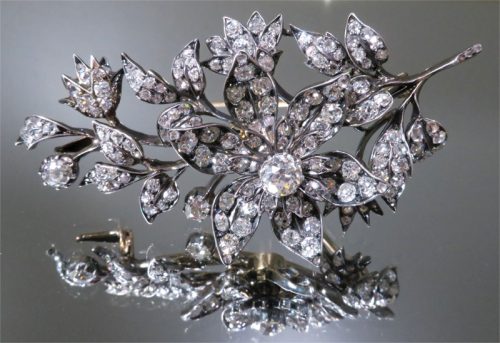
Silver is one of the precious metals, in company with gold and platinum. These “noble metals” are resistant to corrosion. It is for this reason that we still find silver jewellery in ancient archaeological excavations, unlike iron, which would likely have rusted away, or copper, which has turned into a green lump.
Silver has been used as a jewellery metal for thousands of years. The Sumerians, in ancient Mesopotamia (now Iraq), 4,500 years ago, were known to work in both silver and gold. Jewels from that period are still occasionally found. Sadly, when the Iraq museum was looted, some remarkably important historic jewels were lost, likely forever.
In the 21st century, outside of museums, we’re unlikely to encounter many jewels from 2,500 BCE. However, we often see antique silver jewellery, just not quite as antique as the treasures from the ancient peoples of the Middle East or the many African nations whose artists also worked in silver thousands of years ago. In a more modern context, many of our recent ancestors’ jewellery boxes contain a treasure trove of little white metal brooches, rings, necklaces, and bracelets.
If you have white metal jewellery made before the 20th century, it’s very likely that the white metal was silver. Platinum was known in pre-colonial South America, has been found in particles in jewellery from ancient Egypt, and was occasionally used in the late 19th century, but it didn’t become widely used until the early 20th century, when a reliable method of melting platinum was discovered (oxygen and acetylene).
A natural alloy of gold and silver, two elemental metals that are sometimes found and mined together, was sometimes melted to create a metal of a whitish colour, which we call “electrum”. However, white gold as we see it today, originally an alloy of gold and palladium, became standard and gained wider use only in the first quarter of the 20th century.
So, white metal jewellery from before 1900 is usually silver. The colour of silver is warm; it isn’t as starkly white and colourless as platinum. It’s a bright, reflective metal that develops a rich patina, producing unique reflective properties. Silver is a somewhat soft metal and tends to have a soft appearance when polished; this helps with the warm feel of the metal.
Silver used for jewellery usually has a fairly high purity. The standard for jewellery is “sterling”, which has a proportion of 92.5 per cent silver and 7.5 per cent of alloying metal (usually copper). Pure silver is a little soft for jewellery use, and the alloy gives extra strength.
One of the most common places we see silver in antique jewellery is in settings for diamonds. As we have noted, platinum and white gold were not available, and white diamonds look their best when mounted in white metal. Silver was the white metal available, so until the 1880s, we used silver as the material for diamond settings.
These days, when we see antique jewellery set with diamonds, the silver has done what silver does: it has oxidized and has a black or grey colour. The metal is maybe 140 years old or more, so it has earned its tarnish. However, when a necklace set with diamonds mounted in silver was originally made, the metal was a bright, shiny white, perfect to show diamonds at their best.
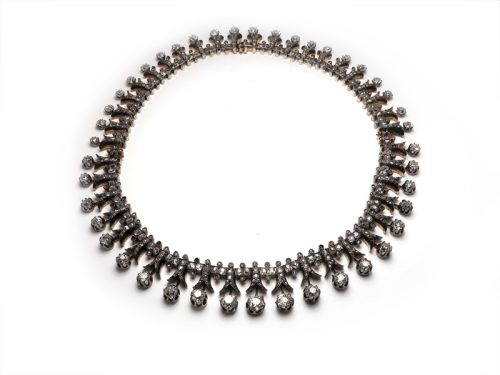
I’ve seen situations where a jeweller has repaired or altered an antique jewel that was silver, blackened with natural oxidation, and then polished it or placed it in a pickle pot, removing the distinctive black colouration. The customer is usually livid: “You’ve ruined my jewel”. Reasonably, the owner of the jewel thought it was originally made with that blackish colour. It is, of course, possible to re-blacken silver, if necessary.
It’s common to see antique silver and diamond jewellery with gold applied to the back of the piece. There are a few reasons for this: silver is a little soft, and gold adds strength to the jewellery, as well as reducing the risk of bending. Also, if the jewellery is a necklace or brooch, the silver may leave a slight smudge of grey on light-coloured clothing, and gold will not. Gold is the more precious and prestigious metal, and silver is the white metal used for diamond settings, but gold is present to show it’s a fancier jewel.
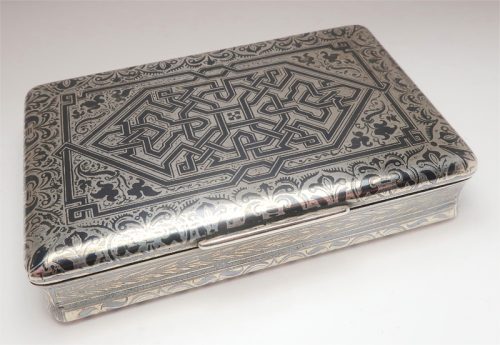
In many parts of the world, sterling silver flatware (cutlery) and holloware (serving vessels, trays, candlesticks and the like) are signs of luxury. A sterling silver candlestick indicates glamour and elegance. Sterling silver jewellery conveys the same story, perhaps not quite as much as gold does, but it holds its place well.
Historically, like today, silver has served as the entry-level jewel for younger people or those with a more modest budget who still want “real” jewels. Gold is trading at a crazy price right now, so silver is much more modest by comparison, but the difference wasn’t always so huge: In 1880, one ounce of gold could buy 18 ounces of silver. Try doing that calculation today!
Often, people would opt to buy several interesting, amusing, or artistic smaller pieces of jewellery in silver instead of a single major jewel in gold. This choice would allow for a fuller jewellery wardrobe, with far more choices, and, at the same time, fit into a more modest budget. The same applies today.
Brooches and earrings were, perhaps, most common among silver jewels in the 18th and 19th centuries. Sentimental messages could be conveyed through a brooch, sometimes with an image, perhaps a rose that happens to mean “love” in the language of flowers, or sometimes quite straightforward messages were spelled right out, “don’t forget me,” perhaps as a gift to someone who requires an aide-mémoire. The wearer could change it up, but, like today, people would tend to accessorize and wear matching metals.
Accessorizing has always been part of wearing jewellery. If someone were wearing silver earrings, they would likely also wear a silver bracelet and brooch. If I were wearing amethyst earrings, I would likely also wear an amethyst brooch, for example. Frequently, silver jewels, both historically and today, have featured larger visible areas of metal than gold jewels. This is partly because silver was less expensive, allowing us to use more of it than gold, but also because the play of light on metal can produce lovely effects. We often see larger areas of silver with engraved designs or delicate wire filigree, which produce areas of light and dark that attract the eye.
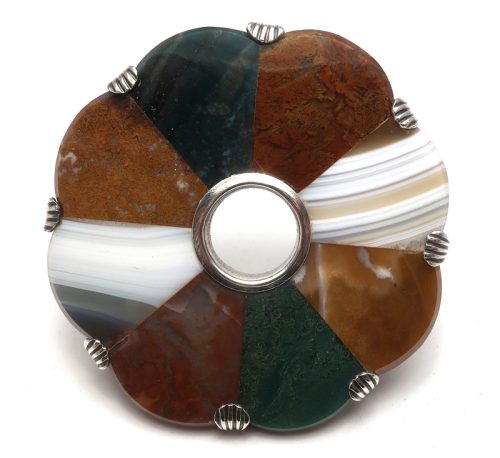
Silver, being a less costly metal, is often associated with less costly gems (with the exception of diamonds, which are best suited to the white metal of the day, as we have already discussed). Antique silver jewels often feature agate, citrine, amethyst, sard, carnelian, and so on.
Silver jewels have been made all over the world, and we still see that today. In the United Kingdom, silver holds a hallowed place and is carefully hallmarked. Historically, hallmarking in the U.K. has, at times, included a mark to indicate that duties have been paid, a mark to indicate the city where the metal was assayed (tested for purity), a letter indicating the year of the assay, and a stamp indicating the maker of the jewel. Other countries have similar sets of marking requirements, so looking for hallmarks can tell us a lot about a jewel, including, sometimes, the date of manufacture. Interestingly, I often see English gold jewels that are less thoroughly hallmarked than many English silver jewels.
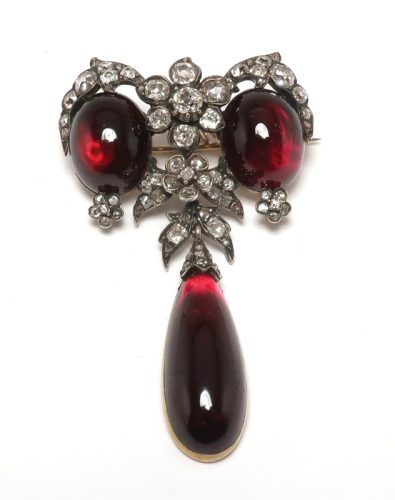
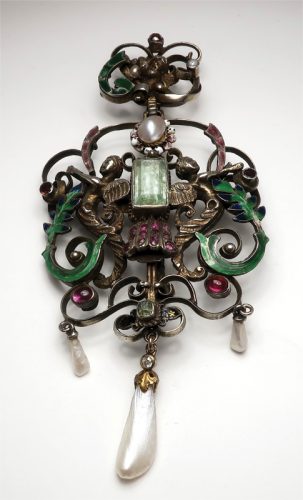
Art jewellery, outside of the mainstream large-scale production, has long focused on silver as the metal of choice. Part of this is budget, and part of it is the warmth and workability of silver. Between 1880 and 1930, during the Arts and Crafts movement, one-of-a-kind handmade jewellery was commonly made in silver, with coloured gemstones, cabochons, and enamel work. This movement coincided with the suffragette movement, which fought for women’s right to vote, and it also saw an increase in women working alongside men at jewellery benches. It took a while before we saw the women’s names and trademarks on jewels; women were often part of collectives, but soon enough, their individual names were featured.
Silver has a rich and revered history, and we regularly see very wearable antique silver jewels. Whether a jewel is a Victorian aide-mémoire for a forgetful lover, or a handmade arts and crafts pendant, there is a great deal of beauty and history in antique silver jewellery. It might even be worth considering having your clients place some of their antique silver jewellery in your estate counter.
Duncan Parker, FGA, FCGmA, CAP-CJA, is vice president of Dupuis Fine Jewellery Auctioneers, based in Toronto. He has worked as a gemmologist and jewellery specialist, appraiser, and consultant for nearly 35 years. Parker is an educator and lecturer on jewellery subjects and has been a speaker at international conferences with a focus on jewellery history. He has served as president of the Canadian Gemmological Association (CGA) and Jewellers Vigilance Canada (JVC). Parker can be reached at duncan.parker@dupuis.ca.
Sign up for our newsletter
Get all the latest news and features from Jewellery Business. Submit your email below to get our twice-monthly newsletter.
Products

Read the Latest Issue
