
Unveiling the science behind gemstone colours
Discover the interplay of light and chemistry that gives gemstones their stunning hues
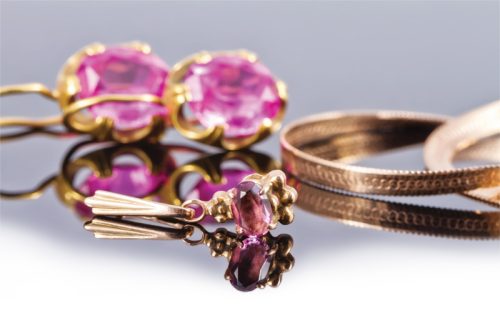
Ever wondered why gemstones are the colour they are? Colour is one of the most captivating and defining characteristics of gemstones. We often choose our jewellery, clothes, accessories and paintings in our favourite colour. Colour has the power to affect our moods and is omnipresent in our daily lives. Did you know that colour is a product of complex interactions between light and matter, and in the case of a gemstone, the gemstone’s chemical composition and its unique crystal structure.
Allochromatic and idiochromatic
To understand how colour forms in gemstones, it is essential to explore the physical, chemical, and optical properties that contribute to this phenomenon.
Gemstones fall into two categories when it comes to how they achieve their colour: allochromatic and idiochromatic.
Another name for allochromatic stones is “other coloured.” Initially clear by nature, they acquire colour as they form in the Earth. The acquired colouring elements, also known as “transition elements”, trace elements, or impurities, do not form a part of their chemical composition. The transition elements are titanium, copper, manganese, vanadium, iron, cobalt, nickel, and chromium. Each one of these elements, or in some cases a couple, gives us the colour we love so much in our gems. These elements can absorb specific wavelengths of light, giving the gemstone its unique colour. For example, chromium is responsible for the red colour in rubies. When chromium ions are present in the crystal structure of corundum (the mineral family to which rubies and sapphires belong), they absorb certain wavelengths of light, leaving behind the red appearance. Iron and titanium are responsible for the blue colour in sapphires. These elements absorb yellow and red light, leaving the blue wavelengths to dominate. Copper can create a green or blue colour in gemstones like turquoise and Paraiba tourmaline. Vanadium produces the green colour in emeralds, while manganese contributes to the pink colour in sapphires.
Idiochromatic stones are self-coloured. Their colour is part of their own chemical make-up. For example, turquoise’s chemical formula is CuAl6(PO4)4(OH)8 • 4H2O, copper is a key component to its chemical make-up and the colouring element. Iron causes the bright green of Peridot and the rusty red of almandine Garnet. Malachite is also coloured by copper, and spessartine Garnet’s rich orange is from manganese. Most gemstones are allochronic and very few are idiochronic.
Light as an influence
Colour in gemstones can also be attributed to how they interact with light. Light is made up of electromagnetic waves, and when light strikes a gemstone, it can either be absorbed, transmitted, or reflected. The way these interactions occur depends on the gemstone’s composition and internal structure, which are unique to each mineral.
When white light (which is a combination of all visible colours) hits a gemstone, the material absorbs some wavelengths of light while allowing others to pass through. The wavelengths of light that are absorbed depend on the energy levels of the atoms or ions within the gemstone. The wavelengths not absorbed are either transmitted through the gemstone or reflected back to the observer’s eye, creating the gemstone’s visible colour, or how we perceive colour. If a stone absorbs all the light, it will look black, and if all the colours pass through it, it will appear colourless, like a diamond, for example. The colour we see is the colour that isn’t being absorbed into the stone.
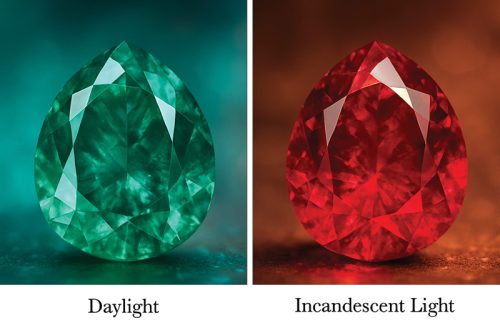
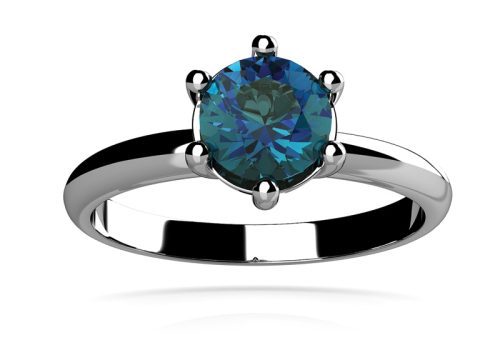
There are always unique stones that bend the rule of colour—take Alexandrite, for example. Alexandrite fluctuates between red and green. Given alexandrite’s unique crystal structure, it actually has a spectrum that balances between red and green. When it is in daylight, which has more blue-green light, it appears green; in incandescent light, which has more red, it appears red.
In addition to the chemical composition, the arrangement of atoms in the crystal lattice (the three-dimensional structure that forms the gemstone) affects how light interacts with the material. This arrangement determines the absorption and reflection of light at various wavelengths. For example, gemstones with a regular, ordered crystal structure may allow light to pass through them more efficiently, creating a clearer, more vibrant colour.
In some cases, the way light interacts with the crystal lattice can produce optical effects such as pleochroism, where a gemstone exhibits different colours when viewed from different angles. This effect occurs because the gemstone’s crystal structure absorbs light differently depending on its direction of entry.
Scattering light
Light scattering can cause colour variations and change our perception of colour.
In some cases, the internal structure of a gemstone, such as the presence of inclusions or microscopic defects, can scatter light and influence the way colour is perceived. For example, diamond has remarkable brilliance and dispersion due to its crystal structure, but with innumerable minute cloud inclusions can cause the diamond to look milky instead of a colourless brilliant gemstone.
Certain gemstones may display colour zoning, where the colour varies across the surface or within the body of the stone. This occurs when the gemstone’s crystal grows under different environmental conditions, causing varying concentrations of trace elements. For instance, tourmaline can exhibit a range of colours from green at one end to pink or red at the other, depending on the concentration of elements like iron, chromium, and manganese.
Treatments
Did you know that treatments can also cause the colour of a gemstone to change, giving it our favourite hue?
Gemstones can undergo various treatments to enhance or modify their colour. Heat treatment is commonly used to intensify the colour of sapphires and rubies. By heating the gemstone to high temperatures, impurities or trace elements can become more stable, altering the absorption of light and enhancing the gemstone’s colour. For example, heat treatment can turn a pale-yellow sapphire into a more intense blue.
Similarly, irradiation is a treatment that uses high-energy radiation to alter the colour of gemstones, typically turning them into shades of green, blue, or purple.
Understanding the science behind gemstone colour helps us appreciate the natural processes that create these dazzling hues and the rich variety of colours found in the world of gemstones. Next time you are looking at a stunning sapphire in the window of a shop, appreciate it for the stone it is, and how Mother Nature created such a colour.
Breanne Avender is a fellow of the Canadian Gemmological Association (FCGmA), a fellow of the Gemmological Association of Great Britain (FGA) and has a Bachelor of Fne Arts degree in Jewellery and Metals from Alberta University of the Arts. She is a Calgary-based gemmologist and jeweller. She is currently on the Canadian Gemmological Association board of directors.
Archana B. Jaswani, FCGmA, PJA, is a gemmologist and a fashion industry professional focused on creating gemstone-infused designs. Currently, she serves as the communications director on the CGA board and teaches diamond grading, as well as general interest courses.
Sign up for our newsletter
Get all the latest news and features from Jewellery Business. Submit your email below to get our twice-monthly newsletter.
Products





Read the Latest Issue
